Showing posts with label Hamas. Show all posts

Friday, 25 July 2014

Our BBC Problem

BBC avoids giving audiences the whole picture on Hamas’ pre-ceasefire demands

There is nothing novel about BBC misrepresentation of Israel’s naval blockade on the Gaza Strip and the restrictions placed on the entry of dual-use goods to that territory. However, that topic now moves into the limelight once again because one of the demands put forward by Hamas – and, significantly, now backed by the PA – is the lifting of the blockade as a pre-condition for a ceasefire to bring an end to the current hostilities.
” “We reject the cycle of ceasefire and negotiations,” said Hamas’ political chief Khaled Mashal on Wednesday night at a press conference in Qatar. “We rejected it today and we will reject it in the future.”
Mashal said the Gaza-based group “would not accept an initiative that does not include lifting the blockade. Today Israel is worried about what happened at Ben Gurion Airport. Do you want a blockade in return for the blockade? Today the resistance in Gaza can blockade you, in the future it will from the West Bank.”
“You blockade our air space, we will blockade your air space,” threatened Mashal.”
That Hamas demand, among others, has been voiced numerous times over the past couple of weeks, but notably recent days have seen it being amplified – and justified – in BBC coverage along with the concurrent and similar Hamas demand regarding the border with Egypt.
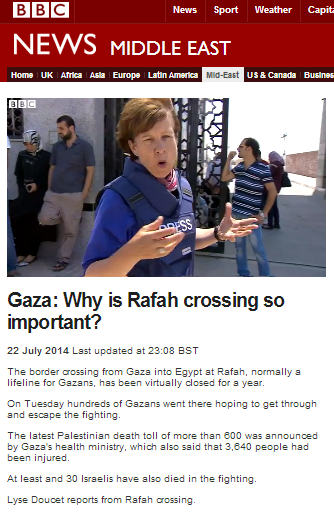
On July 22nd Lyse Doucet was to be found in Rafah. The filmed report she produced – aired on BBC Television news and promoted on the BBC News website under the title “Gaza: Why is Rafah crossing so important?” – opens with an airbrushed explanation as to why that crossing has been closed for much of the last year or so, in much the same way as her colleague Yolande Knell reported on the same topic last August.Crossings Rafah Doucet
“Rafah crossing. Gaza’s only opening to the world which isn’t controlled by Israel. But the road to Egypt has been all but shut for the past year. Relations between Hamas and Egypt are badly strained.”
Notably, Doucet makes no mention of the Gaza Strip-based Salafist groups which have committed acts of terrorism in Egypt’s northern Sinai area and no effort is made to present the Egyptian viewpoint.
After some scenes of people unable to cross the border, Doucet tells viewers:
“A crossing like this is a relief valve for the people of Gaza. For most who live here this is their only way out, which is why during these difficult ceasefire talks, opening the road to Egypt is one of the main demands.”
Later Doucet turns her attentions elsewhere.
“Israeli attacks are striking at the very core of Gaza life. Water pipes, electricity lines, sewage systems have been hit and hit.”
Doucet of course refrains from informing viewers that on at least two occasions since the beginning of Operation Protective Edge, terrorists in Gaza have cut off the electricity by damaging power lines with missiles fired at Israel and that – despite ongoing attacks – technicians from the Israel Electric Corporation went out to repair those high voltage lines. Other repair operations to infrastructure in the Gaza Strip carried out by Israel can be followed in COGAT’s daily updates
Doucet goes on:
“Even before this war most Gazans didn’t have running water or more than a few hours of electricity. A seven-year Israeli blockade – ever since Hamas came to power – is paralysing the economy. Israel says it’s a security measure but it’s choking life here.”
Here we see yet another BBC report erroneously attributing problems in the Gaza Strip exclusively to Israel’s policies when in fact – like the shortages of medicines – the issues with electricity and fuel supply have nothing to do with Israel and everything to do with internal Hamas-Fatah disputes.
Not only does Doucet imply to audiences that there is room for doubt regarding the real reasons for Israel’s policy with her use of the phrase “Israel says it’s a security measure”, but she fails to inform them that those policies – in fact implemented three months after Hamas carried out its violent coup in the Gaza Strip – were a direct response to escalating Hamas terror attacks.
So, Doucet erases the core issue of terror against both Egypt and Israel from the picture she presents to audiences of border restrictions affecting the Gaza Strip. She closes with this context-free promotion of Hamas messaging:
“In Gaza today they were clearing rubble again. War has made life much harder. But for Gazans ending the war must mean easing the blockade, otherwise life itself is just a long battle to survive.”
The day after that report, July 23rd, viewers of BBC television news saw another one by Yolande Knell which was promoted on the BBC News website under the title “Middle East crisis: Normal life on hold in Gaza“. That report found Knell once again visiting a market in Gaza.
“The market here is really one of the only places you can find a lot of people. We’ve been asking them what do they want from a ceasefire deal.”
Woman: “To lift the siege, open the borders of Gaza and to let everything in. And free the prisoners from Israeli jails. This is the most important part of the conditions.”
Man: “Open the borders, have a – you know – promise from Israel that they will not do this what they did again. We want our rights, we want our freedom, we want our state. We want to be safe from their jets and their rockets.”
Knell continues:
“One positive sign for the truce efforts has been general support for Hamas’ demands from the other Palestinian factions. I’ve been to see Fatah parliamentarian Faisal Abu Shahla.
Abu Shahla: “They decided that…to accept the Egyptian initiative but at the same time that the requirements for the Palestinians, especially in Gaza, should be achieved.”
She closes:
“Everywhere you look in Gaza there’s so much evidence of the death and destruction that this latest fighting has brought and that’s why people here are really insisting that any deal to bring peace should be comprehensive and long-term.”
Yet again, no effort whatsoever is made to explain to BBC audiences how the actions of  terror organisations from the Gaza Strip caused two neighbouring countries to implement policies to protect their own citizens.
Recent written BBC reports on the same topic have been no better. An article titled “Gaza conflict: Abbas backs Hamas ceasefire demands” which appeared on the BBC News website’s Middle East page on July 23rd opens:
“Palestinian President Mahmoud Abbas has backed calls by Hamas for an end to the economic blockade of the Gaza Strip as a condition for a ceasefire.”
It later goes on to state:
“Hamas, which is dominant in Gaza, says it will not agree to a ceasefire that does not allow for freer movement of goods and people across its borders.
Rami Hamdallah, the prime minister of the new unity government backed by Hamas and Fatah, said it was time to end what he said was the cycle of unrelenting suffering for the Palestinians.
“We demand justice for our people, who everyday and since the beginning of the Israeli occupation have been subject to the occupation for 47 years,” he said.
“It’s time for this aggression to stop and it’s time for this siege to stop.”
Mr Abbas, a co-founder of Fatah, also chairs the Palestine Liberation Organisation, an umbrella group which has endorsed Hamas’s ceasefire demands.
Israel imposed restrictions on the Gaza Strip in 2006 after Hamas abducted Israeli soldier Gilad Shalit. The measures were tightened by Israel and Egypt in 2007 after Hamas ousted rival Fatah and forcibly took control in Gaza after winning elections the year before.”
Israel has of course not occupied the Gaza Strip for nine years, but that point is not clarified to readers. Again, no mention is made of the fact that it was the escalation of Palestinian terrorism following the June 2007 Hamas coup which caused the Israeli government to declare the Gaza Strip a hostile territoryin September 2007.
This article also includes further promotion of the falsehood that the shortage of medicines in the Gaza Strip is caused by Israeli policies by including the item broadcast on BBC Radio 5 live on the same day.
An additional article titled “Hamas says Gaza blockade must end before ceasefire” which appeared on the BBC News website’s Middle East page on July 24th begins:
“The leader of Islamist militant group Hamas has said there can be no ceasefire to ease the conflict in Gaza without an end to Israel’s blockade.
Khaled Meshaal said Hamas would continue to reject a lasting ceasefire until its conditions were met.”
Later on it states:
“In addition to lifting the eight-year economic blockade, Mr Meshaal’s list of demands also included the opening of the Rafah border crossing with Egypt and the release of Palestinian prisoners.
“We will not accept any initiative that does not lift the blockade on our people and that does not respect their sacrifices,” Khaled Meshaal told reporters at a news conference in Qatar on Wednesday.”
Yet again no information is given to readers regarding the terror attacks on Israeli civilians by Hamas and other terrorist organisations which brought about the restrictions.
“Israel imposed restrictions on the Gaza Strip in 2006 after Hamas abducted Israeli soldier Gilad Shalit. The measures were tightened by Israel and Egypt in 2007 after Hamas ousted rival Fatah and forcibly took control in Gaza after winning elections the year before.”
Another article appearing on the BBC News website’s Middle East page on July 24th under the title “Gaza: Hamas seeks to emerge stronger” was written by Yolande Knell. One of many notable features of that report is yet another inadvertent documentation of the fact that Hamas uses civilians in the Gaza Strip as human shields.
“The only place where we have been able to approach Hamas spokesmen is at the Shifa Hospital in Gaza City where they make periodic appearances.”
Another is Knell’s now habitual misrepresentation of Hamas’ international designation as a terrorist organization.
“Israel sees Hamas as a terrorist organisation; the group’s founding charter is committed to the destruction of the Israeli state.”
Knell too presents a portrayal of Israeli policy which completely erases the Hamas terrorism which brought it about:
“They [Hamas] consistently demand that any ceasefire deal must include a release of prisoners from Israeli jails and an easing of the border restrictions imposed on Gaza by both Israel and Egypt.
“Until now we are under a complete suffocating siege and embargo. They have isolated Gaza from the world,” says spokesman, Fawzi Barhoum. “There’s no justification of this crime.”
A blockade of the Palestinian territory was tightened after Hamas seized control of it in 2007, a year after winning legislative elections.”
Gaza Strip-based terrorism against Egypt is also seriously downplayed in Knell’s account and the smuggling of weapons through tunnels under the Rafah border is erased.
“Meanwhile Egypt’s military-backed governments have always had a testy relationship with Hamas because of its ideological links with the country’s Muslim Brotherhood. […]
Hamas wants Egypt to reopen fully the Rafah border crossing. It has said it will not stop fighting until there is a full agreement on the table. […]
Since the Islamist President Mohammed Morsi was ousted from office a year ago, Rafah, Gaza’s main gateway to the world, has been kept shut most of the time.
The Egyptian military has also closed down the network of hundreds of Hamas-licensed smuggling tunnels that ran under its border. These provided a lifeline to the coastal enclave and provided Hamas with vital funds.
The new government in Cairo accuses Hamas of supporting Islamist militants in its restless Sinai region along the Gaza border; a charge it denies.”
Knell provides readers with some ‘man in the Gaza street’ opinions:
“When Egypt offered the deal, the Israelis picked it up but to be honest for the Palestinians it seemed like a trap,” says Ibrahim, from Gaza City. “People want commercial crossings reopened. We want to go back to a normal life.”
“We need a ceasefire that will give us our human rights and end the siege,” a charity worker, Haneen tells me. “We want the Rafah crossing opened so that we can travel again.”
So as we see, five separate items of content over three consecutive days have presented BBC audiences with information on the issue of Hamas’ pre-condition for a ceasefire which exclusively portrays the Hamas view of border restrictions. None of those reports has given readers or viewers an accurate account of how, when and why both Egypt and Israel adopted policies concerning their borders with the Gaza Strip. The terrorism which brought about those policies has not even been mentioned and no explanation has been given regarding the vital role played by the naval blockade and border restrictions in curbing the flow of missiles and other weapons to the Gaza Strip.
Clearly, BBC audiences cannot reach informed opinions or “participate in the global debate” on this very topical subject without that vital information and context.  But the repeated promotion and amplification of inaccurate, politically motivated claims of shortages of medicines and food in the Gaza Strip because of Israeli policies which we have seen across many BBC platforms in the past few days suggests that the BBC has no intention of providing comprehensive, accurate and impartial reporting on this topic and that intends instead to use emotive partial accounts to amplify the same version of the story as is promoted by Hamas. 

Thursday, 17 July 2014

Our Iron Dome worth its weight in 24 kt Gold

An Iron Dome launcher in Ashdod firing an interceptor rocket on July 9, 2014.
An Iron Dome launcher in Ashdod firing an interceptor rocket on July 9, 2014. Photo by Reuters
RELATED TAGS

The Iron Dome system for intercepting enemy missiles and rockets was being hailed as a hero in 2012’s Operation Pillar of Defense. Now, during Operation Protective Edge, its achievements have been even greater. It is hard to imagine the damage and loss of life that would have occurred in Israel without Iron Dome, which has shot down over 900 rockets so far. The 90% interception rate, a slight improvement over its 85% rate in Pillar of Defense, has allowed the home front to keep to a nearly normal routine under fire, buying time for the army to continue with the operation.
Not only has the Iron Dome battery been a remarkable technological achievement, it was developed in just two years and is unusually cost-effective for such a sophisticated, multifacted system.
But it has not been a financial success for Israel’s defense industry, which developed it. For now, they have only one customer: the Israel Defense Forces. A few governments have expressed interest but, for now at least, no other country in the world faces the same immediate missile threat that Israel does.
The main contractor for Iron Dome is state-owned Rafael Advanced Defense Systems, in collaboration with the Defense Ministry’s Administration for the Development of Weapons and Technological Infrastructure (known as Mafat in Hebrew).
Other contractors involved in the project are Elta Systems – a subsidiary of state-owned Israel Aerospace Industries – which makes the radar system; mPrest Systems, 50%-owned by Rafael and the developer of the command and control system; and Comtec Communications, which developed components for radio communications. The Israel Air Force’s Air Defense Command operates the batteries.
Since Pillar of Defense, the system has been improved and adapted, based on the new threats and types of rockets facing Israel, taking into account the lessons learned from previous battles. There are now nine operational batteries, compared with only five during Pillar of Defense, though the last two were put into operation only after the most recent escalation with Hamas.
“The development of the Iron Dome system is continuous. It is better than its predecessors. We’re staying one step ahead of the other side, which has introduced additional missile systems – not just the M75, but also other new systems,” says Mafat’s Yair Ramati.
One of the fundamental goals in developing Iron Dome was to make it efficient and low-cost. “If you take out the cost of the radar – the most expensive component of the system – the cost of each additional battery is relatively marginal. After that, you can decide how many rockets to intercept and to control costs. It’s not an expense on a level that a country needs to think about,” says mPrest CEO Natan Barak, a colonel in the reserves and commander of the navy’s software unit during Pillar of Defense.
The savings are also expressed in limited manpower needed to operate the system, as well as in operational flexibility. For instance, the system only defends school buildings when they are in use, cutting down the number of interceptor missiles that need to be launched. Each interceptor costs a few tens of thousands of dollars.
“We were asked to develop a very inexpensive system,” explains the head of the project at Rafael, who spoke on condition of anonymity. “We invested a lot of money in developing the interceptor and the system in general. We did some very smart things, and we sought very reliable components and systems. We also used a few innovations of our own that have kept costs down.”
This week, the Defense Ministry ordered the companies involved in Iron Dome not to give interviews or speak to the public for now. “The Iron Dome system has many hundreds of successful interceptions behind it. Since it became operational, many improvements have been made and are being made, which brought about significant improvements in its capabilities. Beyond that, for obvious reasons, we cannot provide details,” a spokesman said.
Nevertheless, a lot is known about how Iron Dome works from previous interviews conducted by The Marker.
The radar, developed by Elta, is an active, electronically scanned array radar that scans the sky for a ballistic motor or rocket. When it detects any, it tracks the rocket’s location and determines its type. This data is transferred to the command and control system, developed by mPrest, which processes and assesses the level of threat and the rocket’s projected target.
If it’s determined that the rocket is going to fall outside a protected area – meaning one that is largely unpopulated and/or of no strategic importance – it won’t be intercepted. If it is, the decision is made that it will be intercepted.
The launcher, which includes up to 20 Tamir interceptor missiles made by Rafael, is operated by the Air Defense Command in the field. An interceptor can act independently and complete its mission, even if it loses communication with the ground, thanks to its sighting systems. The battery also has a communication center that connects all the launchers and interceptors in the region.
The brain of Iron Dome is the command and control center, which synchronizes data from the radar system and other sensors, and decides which targets to intercept.
“The moment we see that the threat is going to reach a protected area, we build the interception plans,” said mPrest’s Barak in an interview with TheMarker during Pillar of Defense. “We construct hundreds of solutions and choose the best one. Then we launch the interceptor at the right time so it will meet the threat in the right place. We need to be able to tell whether it’s one threat or several. There’s a program to match each threat, and we confirm that the interceptor is carrying out the program we expected. If there’s a change in the data, the interceptor gets an update, which is how the interceptor meets the target.”
There are many constraints, because Iron Dome operates in a civilian environment and in areas where aircraft are present.
“These factors make interception relatively complex,” explained Barak. “At short ranges, which are the hardest for us, the reaction time from the moment of detection and the moment we know the rocket is going to fall in a protected area, has to be less than a second. We have less than a second to launch an interceptor.”
And if there’s more than one threat? “We have to launch more than one interceptor.”
The batteries are coordinated at the field-commander level. Each of the batteries is independent, though they communicate with each other. If one goes down, the others can fill in, but that scenario is unlikely. “The systems have extraordinary backup,” he said. “It’s rare for a system not to be in complete working order.”
Iron Dome isn’t influenced by weather conditions. And good news for residents of Tel Aviv and farther north: the greater the distance, the better the interception ability.
“The more time we have, the greater the precision,” says Barak. “So Gush Dan [the central region where Tel Aviv is located] can be less afraid. Of course, many parameters must be considered, but in terms of this particular aspect, Gush Dan is easier for us than Sderot.”
Iron Dome uses a very sophisticated algorithm to plan the interceptor’s path, says Rafael. Once the operator presses “confirm,” the system does the optimization and decides when to launch the interceptor. After the launch, the interceptor receives ongoing updates about the target’s location, which it uses to tweak its trajectory so it can reach the optimal interception point.
One of the considerations is whether to intercept the target inside a protected area. Even if the interception can only be done over a populated area, aerial interception is still considered the better alternative. If the target lands in a protected area, there will be a lot more damage than if it is intercepted and a piece of metal falls that can’t cause as much damage.
“Our goal is to reduce the loss of life, to improve the home front’s ability to withstand [the rockets], and we build our forces to that purpose. We understand that with selective, personal warning, we will limit the number of casualties and the amount of damage of the rockets,” said Lt. Col. Gil – whose last name cannot be published – the head of the command, control, communications and warning department in the IDF. “So, if we measure the number of injuries per rocket, we’ve seen a reduction since the Second Lebanon War [in 2006]. Also in the measurement of damage to the economy, which cost hundreds of millions of shekels a day during the war, the goal is to reach a level of a tenth of that, and even less.”
Gil explains that there are a number of sensors, and not just the Iron Dome radar, that identify a rocket launched at Israel. All the information from these sensors is collected by a single system operated by the air force, which then draws a prediction of an elliptical area where the missile is expected to land. The farther and longer the missile flies, the smaller the ellipse. This information is then passed onto a second command and control network belonging to the Home Front Command. This system maps the ellipse onto what are called “polygons,” 235 of which cover the entire country. The IDF then alerts the residents of the relevant “polygon” areas where the missile is forecast to fall – and only them.
That marks a great improvement in fine-tuning threats so as few people as necessary take shelter and disrupt their routine. Israel used to be divided into only 10 regions for missile-warning alerts, and as recently as a year and a half ago there were just 147 regions, said Gil.
This feature will eventually be enhanced by the 388 million shekel ($113.8 million) National Message system – a major Home Front Command project being developed to provide area-specific rocket warnings to civilians by cellphone and other means, not only via sirens. Only parts of the system are complete and operational. The goal is to provide alerts to people in a specific polygon of an impending attack, although it will be possible to also receive warnings of other areas, such as where a user’s parents or children are.


Sunday, 8 June 2014

The Carrier Robot - Zionist Innovation. Keep Our Soldiers Safe

No Driver, No Problem: Israel’s Newest Unmanned Vehicles

By  on June 7, 2014
IDF5

The IDF will soon begin using a special robot to gather intelligence in underground areas. Another vehicle will scan enemy territory before Israeli forces even enter the field. Check out the high-tech vehicles set to hit the ground in Israel.

Major threats are evolving on Israel’s borders every day. Hamas’ underground terror network in Gaza trains daily to infiltrate Israel, as Hezbollah expands its arsenal of weapons on Israel’s northern border. Meanwhile, terrorists in Judea and Samaria attempt to smuggle weapons through crossings and attack Israeli communities.

The superiority of Israel’s technology is its greatest deterrent against these threats. Among its finest tools are unmanned ground vehicles, which could redefine Israel’s capabilities in the near future.
From small devices that enter buildings to large cars equipped with 360-degree cameras, vehicles without drivers are nothing new for the Israeli military. The IDF’s Ground Forces plan to expand its use of these tools, as experts invent new vehicles based on creative and cutting-edge designs.
Small and Clever: The Carrier Robot
In just a few years, soldiers facing the threat of terror tunnels will carry special robots on their backs. The Carrier Robot, capable of scanning areas underground, will accompany infantry fighters and engineers in underground combat if necessary. IDF experts will program the devices to patrol dangerous areas and gather intelligence for soldiers in the field.
IDF7
“The idea is to enter operations with lightweight, portable robots that can function for a number of hours,” explained Major Lior Trablisi, the head of the IDF’s robot and technology unit. The device will do things that no human can, such as mapping entire buildings and terror tunnels. The groundbreaking technology will allow soldiers to understand the exact appearance of any structure, helping them avoid the dangers of underground or urban combat.
IDF6
The IDF prefers endangering a robot to risking a human life, Maj. Trablisi stressed. “A robot doesn’t deal with the same difficulties of lighting, gunfire or breathing [in tunnels],” he explained. Once the IDF determines the cost of building the robot, it will test the device and put it into action.
Man’s Best Friend: Protector at the Front
Another next-generation vehicle is the Loyal Partner, a device that can maneuver terrain like a Hummer or an Armored Patrol Carrier (APC), while carrying weapons and additional technology for the battlefield. “The robot will be used as a line of defense for the forces at the front,” said Maj. Trablsi. “It will be able to move while identifying bombs and the source of gunfire.”
The vehicle’s first model will be ready toward the end of the IDF’s current multi-year plan. “Its main advantage is that it will lower the risks facing combat soldiers,” Maj. Trablisi said. “It will be able to carry out missions without considerations of risks or manpower. It can remain in the field for long periods of time, carrying out missions precisely and providing a relative advantage to soldiers.”
Defender of the Gaza Border
In recent years, unmanned vehicles have multiplied in the IDF’s southern sector. The devices bolster the effectiveness of patrols near Gaza and operate in almost any type of weather. Their major advantage is their success in preventing kidnappings and reducing attacks against soldiers and civilians.
At the beginning of 2015, a vehicle called the Border Protector will begin patrolling the Gaza border area. Like its predecessors, the vehicle will travel with advanced cameras and carry out searches meant to identify terrorists. The newest version of the vehicle will be upgraded so that soldiers can control it from remote areas.
The IDF expects to deploy at least one Border Protector in each battalion stationed along the Gaza border. Soldiers will control all of the vehicles in the same operation room, which can be located long distances from the border area. “It’s possible to guide the vehicle to all sorts of places without operation rooms nearby,” Maj. Triblisi explained.
As their technology advances, robots and remote-controlled vehicles will remain invaluable assets on modern battlefields. In the next generation, they will become indispensable tools for the surveillance of enemy activities, without putting Israeli forces in danger.

Wednesday, 2 April 2014

Palestinian militant misuse of children

Photo

48th anniversary of Fatah celebrations featuring an armed boy
According to the Coalition to Stop the Use of Child Soldiers' "2004 Global Report on the Use of Child Soldiers" there was "no evidence of systematic recruitment of children by Palestinian armed groups." However, there were incidents where children were involved in suicide attacks or other militant operations.According to Human Rights Watch, in 2004, the major Palestinian armed groups, including Al-Aqsa Martyrs Brigade, the Popular Front for the Liberation of PalestineIslamic Jihad, and Hamas "have publicly disavowed the use of children in military operations, but those stated policies have not always been implemented." In part this is because some leaders state they consider children of 16 to be adults.[38] In 2005 Amnesty International condemned the use of children by Palestinian militant groups saying: "Palestinian armed groups have repeatedly shown total disregard for the most fundamental human rights, notably the right to life, by deliberately targeting Israeli civilians and by using Palestinian children in armed attacks."

Human shields

During the Second Intifada (2000–2005) Haaretz reported that Palestinian militant gunmen used civilians and children as human shields by surrounding themselves with children while shooting at IDF forces.
In a 2006 incident the Israeli Air Force warned Mohammed Weil Baroud, a Palestinian leader accused by Israel of firing Qassam rockets at Israel, to evacuate his home in Beit Lahia in the Gaza Strip in advance of an Israeli airstrike. Instead, hundreds of Palestinians, including many women and children, gathered outside Baroud's house. Israel suspended the airstrike out of fear that the civilians would be killed or injured. A senior Hamas official said the new tactic was taken because in previous months Israel has destroyed 58 houses and more than 240 people had been left homeless. After Israel called off the strike, another Palestinian leader said: "We have won. From now on we will form human chains around every house that is threatened with demolition."[]
In October 2009, local Palestinians confirmed that Hamas had fired at Israeli troops from adjacent a UN school for girls where hundreds of Palestinians had sought refuge, leading to civilian casualties
During the November 2012 Operation Pillar of Defense, Hamas was accused of launching rockets from hospitals, schools, mosques and playgrounds. This practice was condemned by Human Rights Watch,[78] the UN Office of the High Commissioner for Human Rights (OHCHR), and the IDF.

Child suicide bombers

According to the Coalition to Stop the Use of Child Soldiers "2004 Global Report on the Use of Child Soldiers", there were at least nine documented suicide attacks involving Palestinian minors between October 2000 and March 2004.
In 2004, the Guardian reported that the Israeli military "accused a faction of Yasser Arafat's Fatah movement of using an 11-year-old boy as an unwitting human bomb after the child was discovered carrying explosive through an army checkpoint in Nablus.[81] In 2009, a 14-year-old was captured by Israeli soldiers and told of being given $23 and a suicide bomber's vest. His family said he was gullible and easily manipulated.
Shafiq Masalha, a clinical psychologist who teaches at Tel Aviv University, wrote in 2004 that 15 percent of Palestinian children dreamt of becoming suicide bombers.] According to Eyad Sarraj, Palestinian psychiatrist and director of the Gaza Community Mental Health Program, a survey by his program found that 36 percent of Palestinians over 12 aspired to die "a martyr's death" fighting Israel.
Former UN Under-Secretary General Olara Otunnu stated in 2003: "We have witnessed both ends of these acts: children have been used as suicide bombers and children have been killed by suicide bombings. I call on the Palestinian authorities to do everything within their powers to stop all participation by children in this conflict."

Manipulation of children

According to some sources, Hamas uses children to transport weaponry and to perpetrate acts of violence against Israeli soldiers and civilians.] This includes grenade throwing, rock throwing, and stabbing attacks.] In 2004, the Coalition to Stop the Use of Child Soldiers wrote that "children are used as messengers and couriers, and in some cases as fighters and suicide bombers in attacks on Israeli soldiers and civilians. All the main political groups involve children in this way, including Fatah, Hamas, Islamic Jihad, and the Popular Front for the Liberation of Palestine."
An Israeli army report accused Palestinian groups of exploiting children by using them for "smuggling, digging tunnels, spying and intelligence-gathering" and by inciting them to violence, as their youthful appearance allows them to more easily approach soldiers and get through check points. The report also noted that much of Palestinian society disapproves of these methods, but accused the Palestinian Authority of not taking appropriate measures to prevent their occurrence.